


Choosing the appropriate Plastiform viscosity is essential to ensure the precision and quality of moulded part inspection. Each part presents specific challenges, and the correct product selection primarily depends on the part's geometry, the complexity of the area to be reproduced, and the inspection method that will be used after moulding.
The importance of viscosity
More fluid Plastiform products are ideal for internal details, narrow cavities, and simple geometries to fill, allowing the material to penetrate completely without leaving bubbles. On the other hand, more pasty formulations offer greater control over complex or inclined external surfaces, preventing dripping and ensuring uniform moulding.
The practical rule indicated by Plastiform itself is to choose the viscosity not only for ease of application but for the material's ability to faithfully reproduce every detail of the part, maintaining dimensional stability and micrometric precision.
Comparison of Plastiform viscosities in part moulding
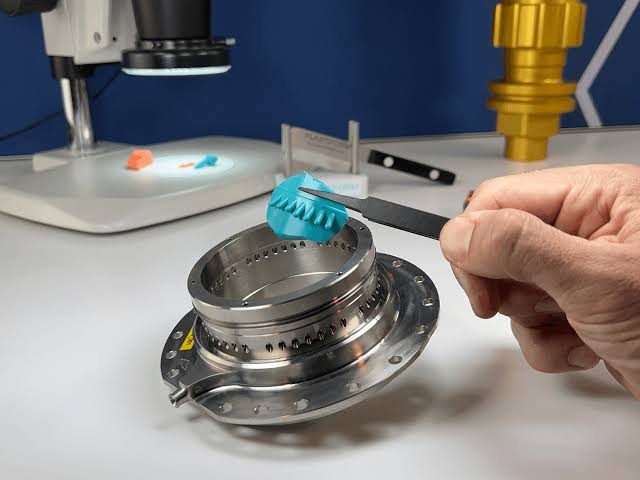
Criteria for Selecting Plastiform Viscosity
Before choosing the right product, ask four key questions:
- Is the area to be moulded internal or external?
- Is there a risk of material leakage or dripping?
- Is the detail to be reproduced very fine, such as microtexture or surface finish?
- Will the measurement be performed with an optical system, profile projector, or another instrument?
Furthermore, part cleanliness is crucial. Dust, grease, or residues can compromise polymerisation and reduce mould precision. Plastiform products allow surface details to be reproduced with micron-level resolution, with a tolerance of ±1 µm, making the choice of viscosity even more critical.
Practical Application Examples
- Channels, threads, and narrow grooves: use a fluid formulation to ensure complete filling and avoid voids.
- Complex external surfaces: prefer pasty products, which maintain their shape and facilitate mould removal.
- Finish or roughness analysis: opt for a viscosity that preserves fine details and dimensional stability, essential for precise measurements.
Best Practices for Using Plastiform
To achieve the best results:
- Prepare the part carefully, ensuring it is clean and dry.
- Apply the Plastiform with the appropriate accessories.
- Observe the curing time indicated by the manufacturer (generally 6 to 8 minutes, with some faster formulations).
- Remove the mould only after complete curing for inspection.
Remember to consider the type of measuring instrument that will be used. Plastiform moulds work particularly well with optical and vision systems, and strategic cuts in the mould can facilitate the analysis of the part's profile.
Practical Suggestion to Simplify the Choice
An efficient approach is:
- Fluid: internal details and hard-to-reach areas.
- Pasty: complex external geometries and inclined surfaces.
- Always with a clean and dry surface before application.
Following this logic, you can reduce failures, increase inspection repeatability, and ensure more precise and reliable results.
At S4METRO, we work with and also sell Plastiform solutions, offering support for those who need precise and non-destructive inspection of complex parts.
To learn more about how to integrate Plastiform solutions into your quality control processes, please contact us.