


Designing a custom component for integration into an aircraft presents unique challenges when space is limited. Once installed, the new element must fit perfectly into the surrounding geometry and the top panel covering it. Even the smallest dimensional deviation can compromise both the functionality and aesthetics of the assembly.
Challenges
How to integrate a custom component into an extremely confined space environment?
To design a new component with a perfect fit, it is essential to accurately capture the geometry of the environment, including the surrounding surfaces and cable routing areas, and generate a rigorous CAD model to serve as the basis for the design. This approach ensures that the new component not only meets tight tolerances but also integrates seamlessly after installation.
What limitations exist in the use of traditional measurement tools and manual data collection?
Manual data collection is inherently slow and prone to errors, presenting obvious limitations in both accuracy and repeatability. In some cases, the geometric complexity or surface characteristics of the parts make it impossible to achieve the necessary level of precision.
What negative consequences does an aerospace company seek to avoid when designing custom components?
The company may not be able to verify certain critical tolerances, compromising the quality and functionality of key components. In aerospace environments, the ability to compare measurement data with CAD models or technical specifications is essential to ensure compliance with required tolerances.
Furthermore, the need to generate detailed technical reports to demonstrate compliance and ensure complete data traceability throughout the product lifecycle reinforces the importance of adopting a more precise measurement solution.
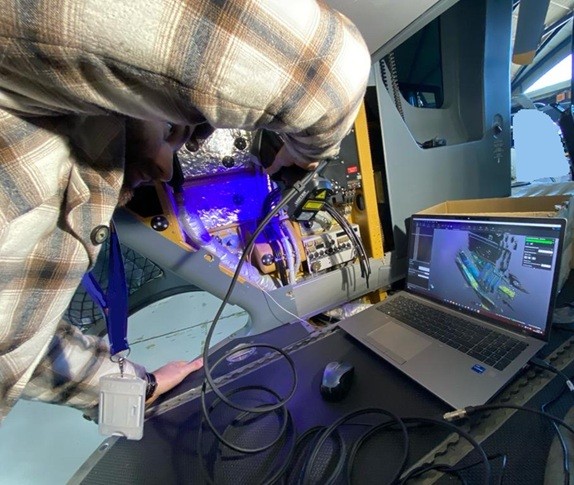
Solution: Accurate, Portable, and Intuitive 3D Scanning Systems
Accuracy
To meet the demands of the aerospace sector, the solution must capture highly accurate and repeatable 3D measurements, even on complex geometries. Professional-grade 3D scanners can consistently ensure this level of accuracy, regardless of the measurement setup or user experience.
Portability
Based on triangulation with optical targets to determine their position relative to the part, portable 3D scanners function as fully autonomous devices, requiring no tripod or external systems. They are compact, easy to transport, and can be used in virtually any environment without compromising accuracy.
Ease of Use
Thanks to an intuitive interface, the solution is simple to operate and allows for rapid adaptation. Technicians can start using it effectively shortly after acquisition and, with additional training, exploit its full potential.
With 2D drawing and 3D modelling functionalities, the software allows engineers to work directly on scan data. Parametric integration with SOLIDWORKS facilitates design changes and feature-based modelling, simplifying the process by transferring real, editable CAD models.
The HandySCAN 3D and the "Scan-to-CAD" reverse engineering module from Creaform, integrated into the Creaform Metrology Suite, are clear examples of accurate, portable, and intuitive 3D scanning solutions.
Benefits: Greater Control and Design Capability for Better Quality Components
Cost-effective investment in time and cost
A professional 3D scanner offers flexibility for design and dimensional control tasks. Having a single tool capable of performing multiple functions represents an efficient investment, reducing training time and maximising return.
Error reduction
With 3D scanning, manual data collection is eliminated. Complex geometries and difficult surfaces can now be measured with high precision, serving as a reliable basis for designing new components and ensuring a perfect fit even in confined spaces.
Quality improvement
The company can confidently verify critical tolerances that might otherwise compromise component performance. The comparison between real data and CAD models ensures that all requirements are met.
Client: Europavia
For over 60 years, Europavia has supplied parts, equipment, and maintenance services to the armed forces and state security entities, specialising in supporting the complete lifecycle of their systems.
The company operates in MRO logistics management, aeronautical maintenance, and the distribution of advanced technology in the aviation, defence, space, and infrastructure sectors in Spain.
Through partnerships with international manufacturers, it provides cutting-edge technological solutions that strengthen the aerospace and defence sectors. With an EASA-certified maintenance centre, it has also expanded its capabilities to engineering and manufacturing services, offering complete integration solutions.
Europavia uses the HandySCAN 3D in solutions that support design, engineering, and maintenance processes on aeronautical platforms. Discover the full range of scanners on S4METRO's Creaform page.